How to show prices on your website in Australia: the total-price rule (2026)
What the Australian Consumer Law and the state consumer regulators say about showing prices on a website: the total price as one figure, GST included, no hidden fees and no drip pricing. Information, not legal advice.
If your website shows a price for goods or services that people usually buy for personal, domestic or household use, you must show the total price as one figure. That total includes GST (the 10% goods and services tax) and every other tax, fee or charge the customer has to pay that can be worked out up front, apart from delivery, which is covered below. It also includes any optional extras you have ticked for the customer in advance. If you show only part of a price, such as a price before a booking fee, you must also show the total, at least as prominently as the part. This is section 48 of the Australian Consumer Law. A misleading price is against the law whoever the buyer is (section 29). From 1 July 2027, a new law also cracks down on drip pricing (fees added step by step through checkout).
This guide is information, not legal advice. Every source was read on 6 November 2026 and is listed at the end.
What the law says
Two parts of the Australian Consumer Law matter for the prices on your website.
Section 48: show a single price. Under section 48, a business must not show an amount that is only part of the price unless it also shows “in a prominent way and as a single figure, the single price”. The single price (the total) must be “at least as prominent as the most prominent of the parts”. It is the lowest total the customer can pay at that moment, including “any tax, duty, fee, levy or charge” on the sale.
Section 29: no misleading prices. Under section 29(1)(i), a business must not “make a false or misleading representation with respect to the price of goods or services”. The single price rule covers goods and services for personal, domestic or household use, but this rule applies whoever the buyer is.
The Australian Government’s business.gov.au puts it simply: “If you display or advertise prices, always include the total price.” It also warns that even if you thought a price statement was correct at the time, “you may still be in breach of Australian Consumer Law.”
What goes into the total price
| Cost | Inside the total price? | Where this comes from |
|---|---|---|
| GST | Yes | WA Consumer Protection; business.gov.au |
| Other taxes, duties, levies and set fees, such as a booking fee | Yes | Section 48(7); business.gov.au |
| Optional extras you have ticked for the customer in advance | Yes. The customer can untick them as they go | WA Consumer Protection |
| Optional extras the customer hasn’t asked for | No | Section 48(7) |
| Delivery or postage | Not usually. If you know there is a minimum delivery charge, you must show that too | Section 48(2) and (3); WA Consumer Protection |
Three worked examples from the regulators:
- A booking fee. A $100 ticket with a $5 booking fee must show $105, for example “$105 (including $5 booking fee)” or “$100 ticket + $5 booking fee = $105” (business.gov.au).
- A pre-ticked extra. A flight advertised at $500 with a pre-selected $10 carbon offset fee “must be advertised at $510 up front” (WA Consumer Protection).
- Taxes and an agent’s fee. A $799 holiday that excludes $150 in taxes and a $200 travel agent’s fee must show the total minimum price of $1,149, at least as prominently as the $799 (Queensland Government).
Part prices and payment plans
A part price is one piece of the total, such as one payment in a payment plan or a price before fees. The regulators call it a component price. You can show it, but you must also show the total as a single figure, at least as prominent as the part price.
The Queensland Government gives the example of an ad for “6 easy payments of $300”. The total of $1,800 was in the fine print and partly covered by a photo, so the ad had to be reprinted “to clearly show the single price”. Showing a single price doesn’t stop you or the customer from negotiating, the same page says.
Drip pricing
Consumer Affairs Victoria describes drip pricing as “where a single price is advertised at the beginning of an online shopping process, and further fees and charges are slowly added (or ‘dripped’)”. It says businesses “must include all charges in the advertised price of their goods and services up front”, including pre-selected options. Drip pricing can break the single price rule if all the costs “could have been presented as a single price from the beginning.”
Who the rule covers, and the exceptions
- Personal and household buyers. Section 48 applies to goods and services “of a kind ordinarily acquired for personal, domestic or household use or consumption”.
- Prices shown only to companies. Section 48 doesn’t apply when the price is shown only to a body corporate (a company). The ban on misleading prices in section 29 still applies.
- Cafes and restaurants. WA Consumer Protection notes the Australian Consumer Law gives cafes and restaurants an exemption from these requirements. The ban on misleading prices in section 29 still applies. Check with your state consumer regulator what the exemption covers.
- Some contracts with regular payments. Section 48(6) turns off the “as prominent” requirement for some services supplied under a contract with periodic payments.
Whether your own prices fall inside or outside these rules depends on your business. If you’re unsure, ask a lawyer or your state consumer regulator.
What happens if you get it wrong
Consumer Affairs Victoria says “civil and criminal penalties apply for failing to comply with single price requirements.” The Queensland Government reports that an airline which didn’t show some airfares on its website inclusive of all taxes, fees and other mandatory charges for 10 months was ordered by the Federal Court to pay a $200,000 penalty.
There is a second risk if the same item shows two different prices. WA Consumer Protection says the business must sell it for the lowest displayed price or withdraw it until the price is fixed. A price in an advertisement counts as a displayed price.
What changes on 1 July 2027
A Treasury media release from Andrew Leigh on 1 April 2026 said the Bill (the proposed law) would “crack down on drip pricing”, aimed at “hidden fees and charges at different stages of a purchase”. It takes effect from 1 July 2027. The law is the Competition and Consumer Amendment (Unfair Trading Practices) Act. Under it, businesses selling personal, domestic or household goods and services will have to show any mandatory transaction-based charges, such as booking or processing fees, at the same time as the base price.
A price check for your website
Each step below comes from the rules above.
- Show GST-inclusive totals. Every price a household customer sees is the total, with GST in it.
- Fold set fees into the first price. If a booking, service or admin fee always applies, it belongs in the price shown first, not at checkout.
- Keep part prices honest. If you show one payment in a payment plan or a price before fees, also show the total as one figure, at least as prominent as the part price.
- Count pre-ticked extras. Anything ticked for the customer by default goes in the total.
- State minimum delivery. If you know there is a minimum delivery charge, say so.
- Change every copy of a price. Price pages, service pages, ads and booking screens all show the same figure. If two prices show, you must sell at the lower one or withdraw the item until it’s fixed.
Compliance built in: the CatalystHub Specialist build
Our Specialist build is for regulated industries and for businesses targeting niche buyers. Its package lists “Industry compliance baked in (AHPRA, ACCC, GST display rules)”. AHPRA is the Australian Health Practitioner Regulation Agency (the health practitioner regulator); ACCC is the Australian Competition and Consumer Commission (the consumer watchdog).
In practice, we build the layout these rules call for, such as prices shown as total prices including GST. We check it before launch. We also check your own words and photos against those rules. It is not legal advice.
The Specialist build is from $1,500 including GST, paid once. It includes everything in our Standard build, plus:
- More advanced custom design, made for your industry: tradie, allied health, cosmetic clinic, real estate or hospitality.
- Industry compliance baked in, covering AHPRA, ACCC and GST display rules, as described above.
- Integrations included: booking tools, Google Business schema (code that tells Google your business details) and capability PDFs (documents that set out what your business can do). We put your existing capability statement on the site for free. A new one is a separate job, quoted separately.
- Up to 15 pages. We count uniquely designed pages. Privacy and terms pages generally don’t count.
- Unlimited revisions. We keep making changes until you’re 100% happy, and nothing goes live until you sign off.
- You own it all: the site, the code, the content and your domain.
- An optional care plan from $79 a month, with compliance update monitoring and 30 minutes of content updates a month. You can cancel any month with 14 days’ notice.
We can write your page words for you, or help you polish your own. Copywriting is offered on every build. Our sites load in under a second on 4G and score 95+ on Lighthouse on mobile (Lighthouse is Google’s speed score).
Specialist builds are delivered within 7 business days of the kickoff call. Every price on our pricing page includes GST. For a smaller site, our Standard build is $500 including GST for 5 pages.
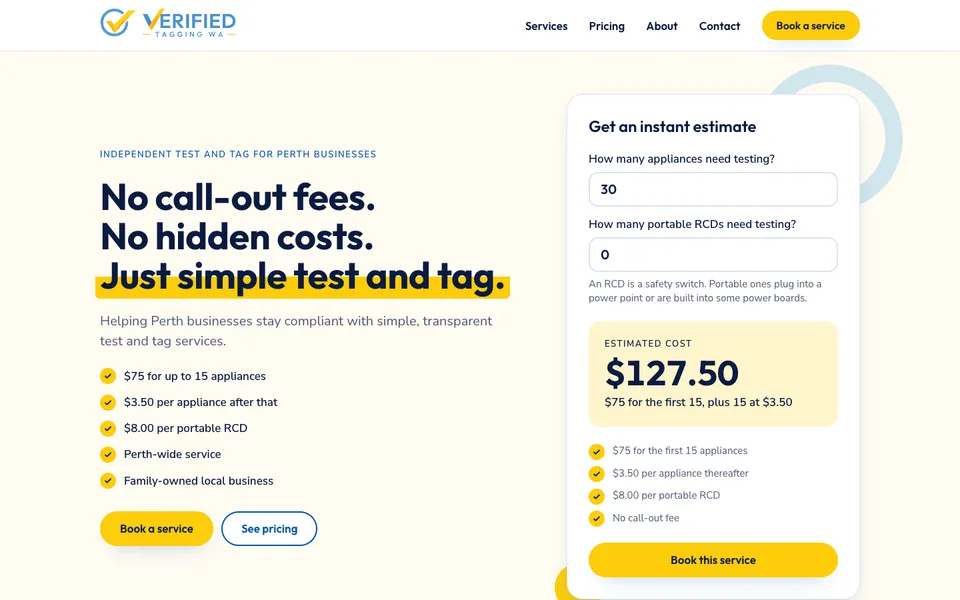
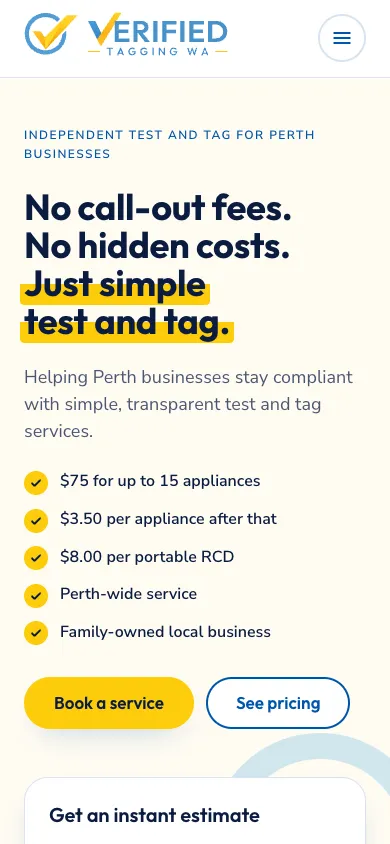
The Aesir Legal website was a Specialist build, for a Perth law firm practising commercial law. Its footer shows the firm’s legal liability statement. You can see it on our work page.
Planning more than 15 pages? See what a website costs by number of pages. We build those too, priced by the number of newly designed pages. We fix the exact price and the timeline in writing on a 30-minute call before you pay. Ready to go? Start a Specialist build.
Frequently asked questions
Do prices on my website have to include GST? Yes, for goods and services people usually buy for personal, domestic or household use. The single price must include any tax, duty, fee, levy or charge on the sale, and WA Consumer Protection names GST as one example.
Can I add a booking fee at checkout? If the fee always applies, it belongs in the price you show first. business.gov.au’s example is a $100 ticket with a $5 booking fee, which must show $105. Adding set fees later in checkout is drip pricing, and it can break the single price rule.
Do I have to include delivery in the price? Not usually. If you know there is a minimum delivery charge, you must also show it.
Does the total-price rule apply to business-to-business prices? Section 48 doesn’t apply to a price shown only to a company. The ban on false or misleading prices in section 29 applies whoever the buyer is.
Sources
All read on 6 November 2026.
- Australian Consumer Law, section 29 and section 48, Federal Register of Legislation
- Competition and Consumer Amendment (Unfair Trading Practices) Act, Federal Register of Legislation
- Banning unfair trading tricks and traps, Treasury media release, 1 April 2026
- Display prices, business.gov.au
- Price display, WA Consumer Protection, last updated 25 November 2024
- Pricing, Consumer Affairs Victoria, last updated 13 October 2023
- Rules for total and component pricing, Queensland Government, last updated 4 November 2026


CatalystHub
From$1,500 inc. GST
for up to 15 pages, with industry compliance and integrations built in
Start my Specialist buildSmaller or bigger project? See all packages and custom quotes