Your website and capability statement: a guide for WA contractors chasing tenders
What WA purchasing officers and tender panels look for, what goes in a capability statement, where WA work is advertised, and how a contractor's website should carry the same evidence, with a downloadable PDF version.
On WA government building tenders, the evaluation panel scores your written offer, not your website. The WA guide “Before you submit an offer” says the evaluation panel “will assess only the information you provide”. Your website does its work around the tender. WA purchasing officers look for “evidence of your capability and experience as a supplier”, and when buying goods and services up to $250,000 that aren’t on a whole-of-government contract, buyers may pick suppliers they’ve found themselves. So a contractor’s website should carry the same evidence as a capability statement: what you do, your key people, your major clients and projects, and your contact details with your ABN or ACN. Business Queensland suggests a PDF version of the statement, and says: “Keep your website up to date and consistent with your capability statement”. CatalystHub’s Specialist build, from $1,500 inc. GST for up to 15 pages, lists capability PDFs among its included integrations, and a capability statement PDF you already have goes on your site for free.
What a capability statement is
A tender is a formal request for prices and proposals. A capability statement is a document that tells buyers what your business can do.
The Small Business Development Corporation (SBDC) says: “A capability statement outlines what you can offer potential clients and provides the essential details to help them decide whether to do business with you.” It adds that many tender applications “require a capability statement to ensure your business can meet the client’s requirements”, and that one can be “incorporated into tender documents” (SBDC, 14 September 2022).
Business Queensland says it is “more than ‘about us’ content. It needs to prove how you can solve problems for prospective clients” (Business Queensland, updated 29 August 2022). We use the Queensland page because no WA government page we found sets out the sections in this much detail.
What goes in a capability statement
Business Queensland lists six core sections:
- Business overview. Who you are and what you do.
- Core competencies. The work you do best.
- Key personnel. For each person: “name, role, experience and qualifications”.
- Products and services. What you supply.
- Clients and projects. “Your list of major clients and examples of relevant projects.”
- Contact details. “Name, title, email, telephone, locations and website, together with the ABN or ACN”. The ABN and ACN are your business and company numbers, the last item in the contact details.
It also suggests optional extras: policies and procedures, accreditations and certifications, awards and recognition, membership of professional associations, client testimonials, community involvement and insurance details.
On length, the SBDC says a statement “could be a couple of paragraphs through to several pages depending on where and how you plan to use it”. Business Queensland says to “keep it short and sharp (e.g. use bullet points and tables, not just long paragraphs)”, to convert it to a PDF because that “is easier to distribute and ensures the content and designs stays the same”, and to “treat it as a ‘live’ document. Keep it up to date.”
What WA government buyers look for
The WA Government’s “Getting government work” guide (last updated 9 February 2024) says purchasing officers will be looking for:
- value for money
- a competitive price
- quality
- “evidence of your capability and experience as a supplier”
It also says “marketing your business to relevant agencies will help to make sure that you are on the radar of potential buyers”, and to “keep your pitch specific and relevant to their needs” (WA.gov.au).
The same guide explains two ways in:
- Direct sourcing. When buying goods and services up to $250,000 that are not on a Common Use Arrangement, buyers “may source from suppliers that they have identified and deem appropriate.”
- Common Use Arrangements (CUAs). These are “whole of government contracts (often called standing offers)”. To get on one, the process “is generally the open tender process”.
The guide also notes that government work gives “a valuable reference that may assist you to secure contracts in the private sector or overseas.” That reference belongs in the clients and projects section of your statement and your website.
Where to find tenders and projects
- Tenders WA. The WA Government calls it “the central source of information on the WA Government’s tenders and contract awards”. Registered suppliers can download tender documents, submit responses online, receive invitations to respond, and get automatic notices of new requests that match their profile (WA.gov.au).
- Local councils and shires. The SBDC says local government tenders “are usually advertised in The West Australian newspaper every Wednesday and Saturday”, and you can “register at no charge” on Tenderlink for notices of calls for tender from WALGA, the WA Local Government Association (SBDC Tenders page).
- Major projects and mining. The Chamber of Commerce and Industry WA (CCIWA) runs ICN WA. Its Gateway by ICN is “a national platform for major projects throughout Australia” and is “free for all Australian businesses to use.” Suppliers create a profile and express interest in work, and “project and procurement teams can then access the information you’ve supplied.” It covers “mining, energy, construction, infrastructure, defence and other major projects” (CCIWA).
For a sense of scale, Rio Tinto says its spending with suppliers in Western Australia reached a record A$10.3 billion in 2024, and that it works with about 2,400 WA suppliers each year (Rio Tinto, 4 April 2025).
The WA Government also publishes separate supplier guides for goods and services, community services, works (building, consultancy and maintenance), subcontracting on government projects, and Aboriginal businesses (Supplying to government).
Building contractors: prequalification and the written offer
Prequalification means being assessed and approved before you’re allowed to bid. The WA Government’s Builders Prequalification Scheme page (last updated 19 November 2025) says: “Prequalify to be eligible to bid for non-residential construction contracts valued over $20,000.” The Department “assesses the financial viability and capacity of contractors” for prequalification and tender evaluation (WA.gov.au).
When you respond to a building tender, the WA guide “Before you submit an offer” says to check you can “deliver the requested scope of work” and “meet the time, resourcing, technical and quality requirements”. It says “it is important that you provide all the information required in the request document”, “the evaluation panel will assess only the information you provide”, and “late offers will not be accepted” (WA.gov.au, updated 15 June 2021). So everything the panel needs goes in the offer itself. A link to your website is not a substitute.
Regional businesses
Under the WA Buy Local Policy 2022, an eligible regional business tendering for works “may have their entire tendered price evaluated as though it was reduced.” The WA page (last updated 7 December 2022) says the price “will typically be reduced by 5 percent up to a maximum of $250,000 (GST inclusive)”, and that “these values may vary between contracts” (WA.gov.au).
Conditions include:
- “maintaining a permanent operational office within a certain distance of the contracted works (as described in the tender)”
- “being staffed by at least one person who resides in the region”
- “being registered or licenced to operate in WA”
- an office established “for at least six months prior to current tender release”
If you rely on a regional office, show the same address on your website and in your capability statement.
What a contractor’s website should include
Your website should let a buyer who finds you check your capability quickly, and say the same thing as your capability statement.
- A clear overview and core competencies. The WA guide’s advice is to “keep your pitch specific and relevant to their needs”.
- Products and services, with what you supply and where.
- Key people, with their roles, experience and qualifications.
- Clients and projects, with examples of relevant work, including any government contracts.
- Accreditations, certifications, memberships and insurance, if you hold them.
- Contact details with locations and your ABN or ACN, matching the statement.
- Your capability statement as a PDF download, kept current, because Business Queensland calls it a “live” document.
How our Specialist build fits
Our Specialist build is made for businesses targeting niche buyers. It’s from $1,500 inc. GST, one-off, and it’s the build we recommend on our pricing page. It’s delivered within 7 business days of the kickoff call. It includes everything in our Standard build, plus:
- More advanced custom design
- Integrations included: booking engines, Google Business schema (code that gives Google your business details in a form it reads directly) and capability PDFs
- Up to 15 pages
- Unlimited revisions
- Security hardening and vulnerability fixes at launch
- An optional case-study write-up, which you sign off or skip
- Free hosting with no ongoing cost
From the Standard build you also get a mobile-first design that loads in under a second on 4G and scores Lighthouse 95+ on mobile (Lighthouse is Google’s speed and quality test), a Word-style editor so you can change words and images yourself, SEO set up for Google and AI search (SEO means search engine optimisation), and privacy-respecting GA4 analytics (Google Analytics 4). You own the site, its code and its content, and if we register your domain, it’s in your name.
Your capability statement PDF
If you already have a capability statement PDF, we put it on your website for free. Creating a new capability PDF is a separate job, and we quote it separately.
We also write the words for your pages if you want us to. Copywriting is offered on every build: if you have your own words, we help you refine them, and if you don’t, we write them for you. AI-assisted copy is free.
Launch and after
Before launch we set up Google Search Console, Bing Webmaster Tools and Google Analytics for free, and keep an eye on them until handover, generally one to two weeks after the site goes live. If we’re replacing an old site, we set up redirects, which send your old page addresses to the new ones.
A care plan is optional. The Specialist care plan is from $79 a month, includes 30 minutes of content updates, and you can cancel any month with 14 days’ notice. Without a care plan, you look after updates and fixes yourself, and we’re still a call or email away at our hourly rate.
Bigger sites
Need more than 15 pages, or a different size? We build bigger sites too. Each newly designed page is quoted at roughly $100 a page up to 15 pages, with a lower price per page above 15. Blog posts and news articles don’t count as newly designed pages, and privacy and terms pages generally don’t count either. As a guide, that’s about $1,000 for 10 pages, about $1,900 for 20 pages and about $2,500 for 30 pages. The exact price is fixed in writing on a 30-minute call, before you pay. For builds over 15 pages, we agree the timeline in writing on the call.
Every build, including sites over 15 pages, gets unlimited revisions until you’re 100% happy. Hosting is usually free: it’s free on our usual setup, and for a bigger project we recommend the setup that fits it best, so your quote confirms the hosting. Our guide to website cost by number of pages has more detail. Anything larger or unusual gets a custom quote, and we do those too.
If you only need five pages, our Standard build is the smaller option at $500 inc. GST.
WordPress or another platform
We’re not tied to one platform. We recommend the setup that suits your project, and you choose. If you specifically want WordPress, or another platform, we build on it. There’s no published WordPress price: we quote it and fix the price in writing before you pay. Free hosting is promised only on our usual setup.
How it starts
A 30-minute call locks the scope, price and timeline, and you get a one-page summary in writing before you pay. Extra pages and development are quoted up front, and quotes are generally valid for two weeks. You can split payments through Klarna, and bigger builds can be paid 50/50: half at the start, half at launch. We’re flexible: scope, timing, payment and what’s included can be adjusted to suit you, and we work it out with you on the call.
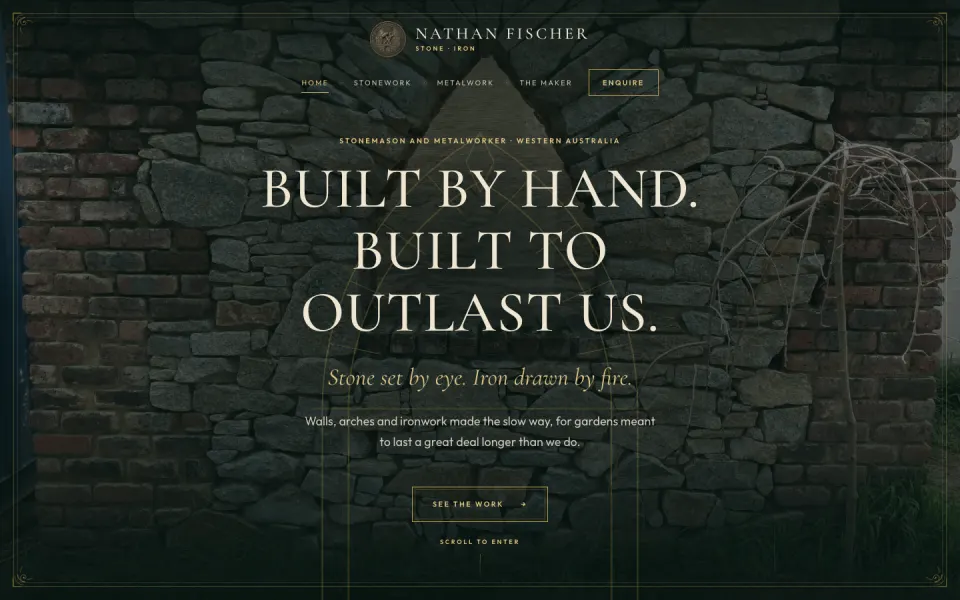
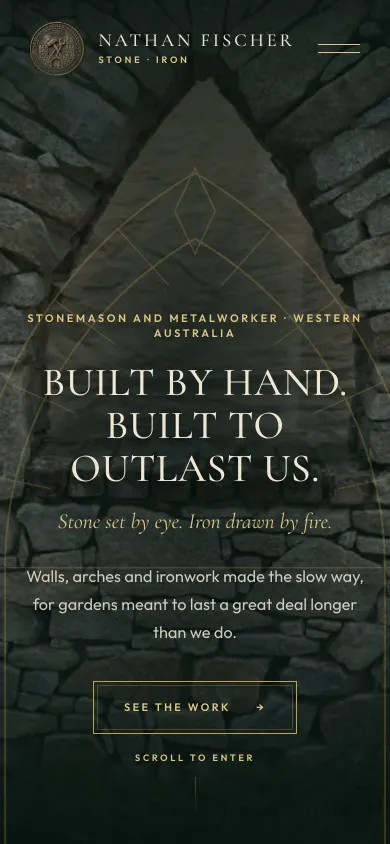
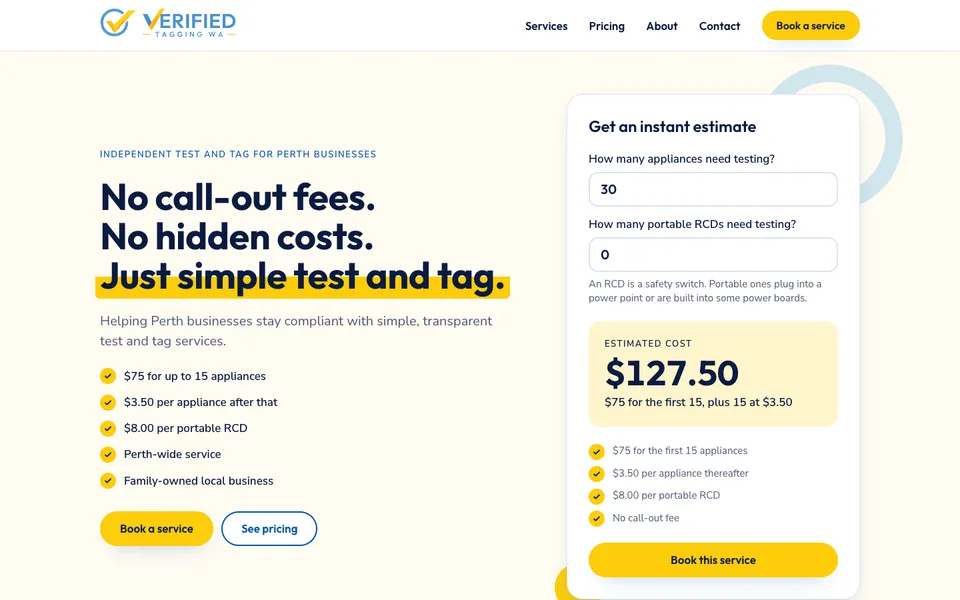
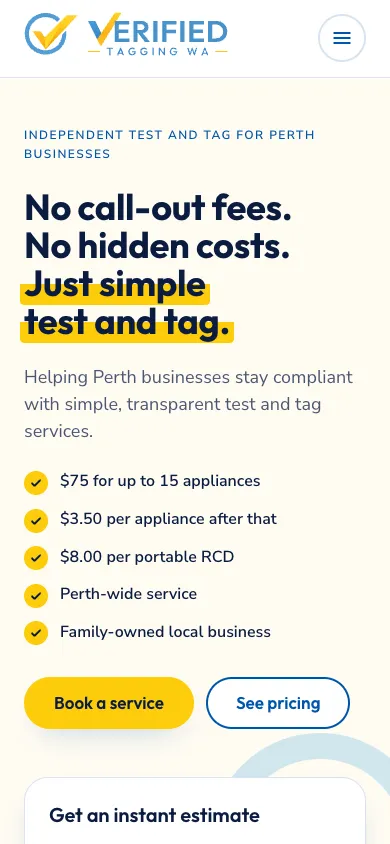
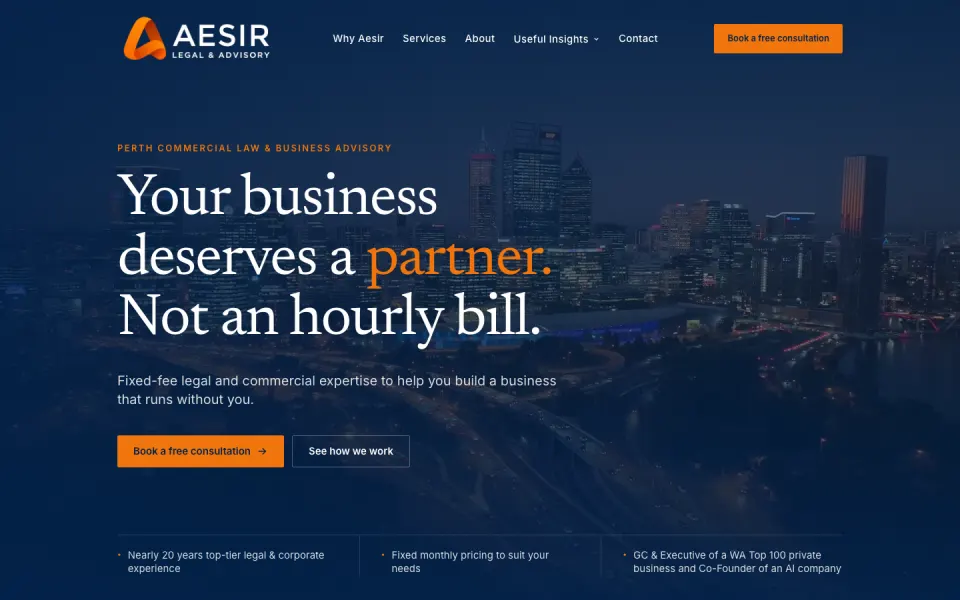
You can see our build quality on a live site for Aesir Legal, a Perth law firm practising commercial law. It was a Specialist build. It’s a law firm, not a contractor, so it shows how we build, not tender results.
Start a Specialist build, or compare every package on our pricing page.
Frequently asked questions
Does a WA tender panel look at my website? The WA building tender guide says “the evaluation panel will assess only the information you provide” in your offer. Put everything the request asks for in the offer. Your website helps buyers find and check you before and outside formal tenders, for example when a buyer sources directly for purchases up to $250,000 that aren’t on a Common Use Arrangement.
What should a capability statement include? Business Queensland lists a business overview, core competencies, key personnel, products and services, clients and projects, and contact details with your ABN or ACN. Optional extras include accreditations, insurance details, awards and client testimonials.
Should my capability statement be a PDF or a web page? Both can work. Business Queensland suggests converting it to a PDF, which “is easier to distribute and ensures the content and designs stays the same”, and also mentions a web version. Whichever you use, keep your website consistent with the statement.
Can you put my capability statement on my new website? Yes. If you already have a capability statement PDF, we put it on your website for free. Creating a new capability PDF is a separate job, quoted separately.
How long should a capability statement be? The SBDC says anything from “a couple of paragraphs through to several pages”, depending on how you’ll use it. Business Queensland says to keep it “short and sharp”, with bullet points and tables.

CatalystHub
From$1,500 inc. GST
for up to 15 pages, with industry compliance and integrations built in
Start my Specialist buildSmaller or bigger project? See all packages and custom quotes